Agricultural employment in decline: where has the workforce gone?
Over the past five years, the agricultural sector lost a third of its workforce. This could be attributed to workers moving to other sectors, higher unemployment, more labor inactivity, or migration — the last two possibly interconnected.
Translated from Spanish with AI assistance and reviewed by our editors. See a translation error? Email us.
Agriculture is a pillar of the Honduran economy
- The sector accounts for roughly 30% of the country's total exports and nearly half of rural employment (Figure 1).Footnote 1[1]
- With nearly half a million workers, it employs more poor people than any other sectorFootnote 2[2] (Figure 2).
Figure 1
Employment composition in rural areas, 2024
This visualization is currently only available in Spanish.
Figure 2
Employment by sector and poverty level, 2024
This visualization is currently only available in Spanish.
Between 2019 and 2024, approximately 300,000 fewer jobs were recorded in agriculture — a reduction of one third of the sector's workforce
- During this period the agricultural sector lost ground in the economy. In 2020, hurricanes Eta and Iota caused significant damage to agricultural infrastructure and key crops such as sugarcane, oil palm, and coffee.Footnote 3[3] These products fell from 35% of agricultural GDP in 2019 to 29% in 2024.
- These adverse climate conditions are one of several factors that have led some farmers — especially in rural areas — to seek opportunities in other sectors, migrate, or stop working altogether.
- In recent years this is reflected in a decline in agricultural employmentFootnote 4[4] six times greater than the loss recorded in the rest of the economy (49,000) (Figure 3).Footnote 5[5] Compared with regional trends, Honduras stands out as the Central American country where agricultural employment fell the most.Footnote 6[6]
Figure 3
Employment by sector, 2019 and 2024 (in thousands)
This visualization is currently only available in Spanish.
This decline is concentrated mainly among men in rural areas
240,000 rural agricultural jobs have been lost, of which more than 207,000 were held by men (Figure 4).
Figure 4
Agricultural sector job losses by gender and area between 2019 and 2024, in thousands
This visualization is currently only available in Spanish.
Employment growth in other sectors does not offset the contraction observed
Between 2019 and 2024, employment in other sectors grew (184,000). Even assuming all of these jobs went to workers who had previously been in agriculture, this still leaves a gap of 109,000 agricultural jobs that were not absorbed (Figure 5).Footnote 7[7]
Figure 5
Change in employment by sector between 2019 and 2024
This visualization is currently only available in Spanish.
Meanwhile, unemployment fell and labor inactivity rose
- The loss of agricultural jobs did not translate into higher unemployment. On the contrary, the share of unemployedFootnote 8[8] people in the country — those not working but actively seeking employment — fell from 4.1% to 3.3%, equivalent to 35,000 fewer unemployed persons.
- By contrast, in 2024, 40% of the working-age populationFootnote 9[9] were neither working nor actively seeking work (Figure 6). This represents nearly half a million more inactive Hondurans compared with five years earlier.Footnote 10[10]
- Moreover, more people report 'household duties' as their main reason for not participating in the labor market (Figure 7). In 2024, more than 1.5 million HonduransFootnote 11[11] — equivalent to 1 in 4 working-age individuals — remained at home and outside the labor force.
Figure 6
Economic activity status
This visualization is currently only available in Spanish.
Figure 7
Why can't or won't you work? Reason for inactivity
This visualization is currently only available in Spanish.
Remittances may be financing this rise in inactivity
- The decline in agricultural employment coincides with an increase in Honduran migration to the United States, particularly irregular migrationFootnote 12[12] in recent years (Van Hook et al., 2025).
- Between 2019 and 2024, the number of households reporting remittance income nearly doubled in rural areas (Figure 8).
- The share of inactive individuals in rural areas who report receiving remittances also rose (Figure 9), consistent with studies documenting the relationship between migration flows, remittance receipt, and withdrawal from work (Carare et al., 2024; Azizi, 2018).Footnote 13[13]
Figure 8
Number of households reporting remittance income in rural areas
This visualization is currently only available in Spanish.
Figure 9
Share of inactive individuals in rural areas who receive remittances, by gender
This visualization is currently only available in Spanish.
The jobs that were lost may have been the least productiveFootnote 14[14]
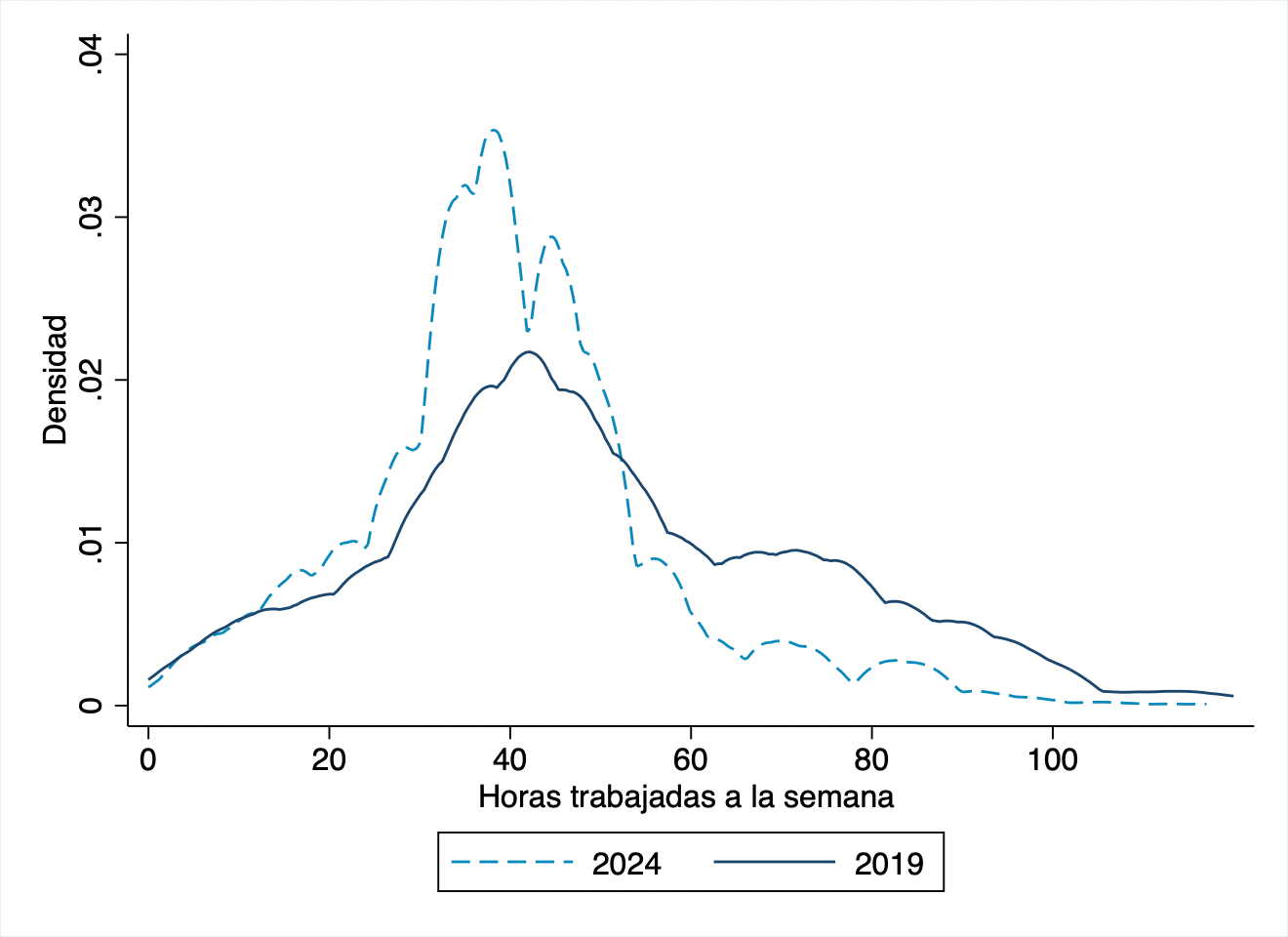
In 2024, the profile of the agricultural workforce shows signs of greater job stability: a lower share of employment in firms with five or fewer workers (Figure 10), a higher number of waged employees (Figure 11), and working hours more concentrated around 40 hours per week (Figure 12).
Figure 10
Agricultural employment by firm size, rural area
This visualization is currently only available in Spanish.
Figure 11
Employment relationship of workers in the agricultural sector, rural area
This visualization is currently only available in Spanish.
Figure 12
Distribution of weekly hours worked by the agricultural sector workforce, rural area (Kernel density)Footnote 15[15]
This visualization is currently only available in Spanish.
This analysis leaves us (again) with more questions to investigate
Job losses in agriculture cannot be attributed to a single factor. Over the past five years, some agricultural workers may have moved to other sectors, emigrated, or stopped participating actively in the labor market. Among these trends, the rise in inactivity — possibly sustained by remittances — stands out.
- On those who stay
1.5 million working-age Hondurans — the vast majority of them women — are engaged in 'household duties'; this is a quarter of our population with productive potential. Even if this group had access to paid employment, 80% indicate they would not be available to take such a job.Footnote 16[16]
How can we create more opportunities and quality jobs to encourage greater labor force participation?
- On those who leave
Those who emigrate typically do so driven by strong motivation and resilience in search of better opportunities. Hondurans in the United States have a labor force participation rate higher than that of the average immigrant and of the American population. Some studies suggest that the absence of these workers could result in significant losses for the U.S. economy. That same energy and capacity could be redirected toward productive activities that strengthen Honduras's economic development.
How can we offer Hondurans the same (or better) opportunities they seek abroad?
If you want to learn more about how this analysis was conducted or need additional information, contact us at econ@sendas.org.