Electricity reform: progress, setbacks, and what cannot wait
How the bill has evolved, and what it means for the sector.
Translated from Spanish with AI assistance and reviewed by our editors. See a translation error? Email us.
This note analyzes how the proposed electricity sector reform has evolved since debate began in the Honduran National Congress: what the proposal gets right, where it moves backward, and what remains unresolved. The analysis draws on the successive versions of the reform bill published by the CREE (Comisión Reguladora de Energía Eléctrica).
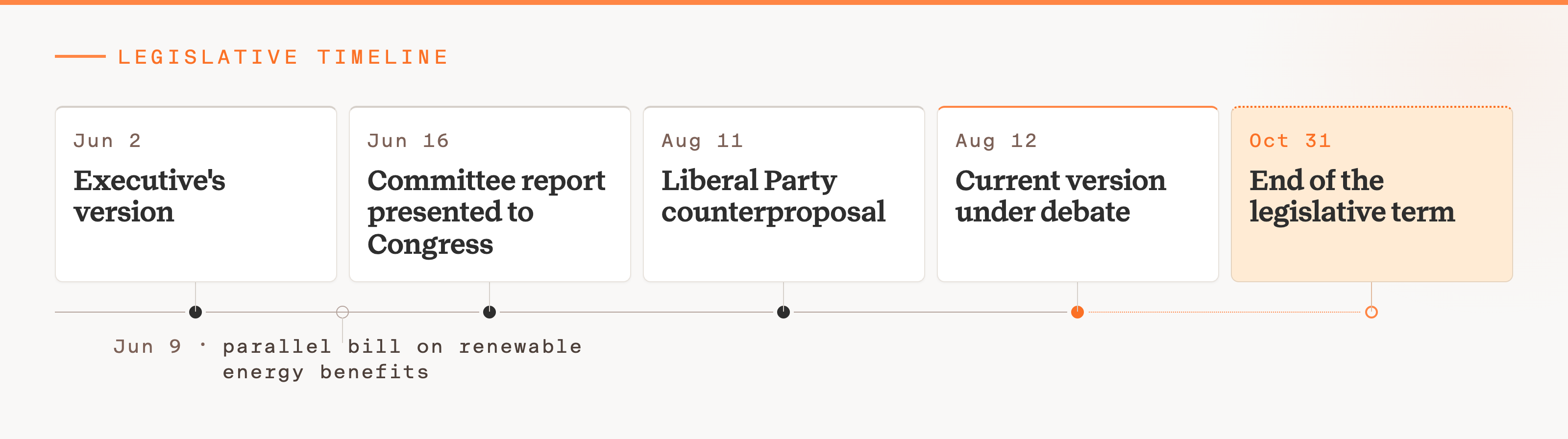
As of August 27, the National and Liberal Party caucuses have narrowed their differences, but the debate remains open. Much of the negotiation has centered on the ownership of the ENEE (Empresa Nacional de Energía Eléctrica). The August 12 version includes safeguards to preserve its status as a public company, including a two-thirds majority (86 votes) to change its legal nature. But ownership was never the core issue. With the right governance, a public company can work well; arguing over whether to privatize it diverts attention from changes that are both necessary and achievable. A parallel initiative offering benefits to renewable energy has further stalled the reform process. But not everything depends on a new law: the legislative impasse should not hold up all progress in the sector.
What does it get right?
The current text preserves the first version’s essential design elements. It maintains the separation of ENEE into three subsidiaries — generation, transmission, and distribution. Each has different functions and needs, and the design keeps them apart accordingly. It also strengthens the CREE’s governance: staggered six-year terms for commissioners, removal only for cause, selection through a nominating board, and greater budgetary independence.Footnote 1[1] It also keeps the System and Market Operator (OSM) independent of ENEE, preventing the state utility from serving as both a market participant and the market operator.
The text also strengthens financial discipline. Subsidies must be explicit, targeted, and funded from the budget, without shifting costs among users or encouraging inefficient use of public resources; any state support must be tied to targets and indicators. The Fondo de Prestaciones Sociales (FPS-ENEE), the utility’s employee benefits fund, would no longer automatically become a separate legal entity: it must first demonstrate its viability through an actuarial study and a review of its assets and liabilities. That reduces risks to workers and the state.
Where does it go backward?
The proposed design gets the structure right, but not the incentives.
The most fundamental setback is that ENEE Matriz (the holding company) remains.Footnote 2[2] The coordination that might justify ENEE Matriz already exists elsewhere: the CREE handles regulation, while the OSM handles system and market operations. By granting ENEE Matriz the power to appoint the subsidiaries’ boards and approve their key decisions, the proposed design creates a channel for political influence over all three companies. The governance of the OSM also differs. The proposed three-member independent board is replaced by ten directors selected by market participantsFootnote 3[3] — a departure from best practice, which favors boards independent of the industry they oversee.Footnote 4[4] The design has a rationale, though: with all market segments represented and no single group holding a majority, the usual risk of a stakeholder board — one interest dominating — is at least contained. It is not the standard governance model, but it is a defensible compromise given the alternative of no consensus on an independent structure.
The law’s earlier versionsFootnote 5[5] transferred the assets to the new companies; the August 12 version consolidates them in ENEE Matriz,Footnote 6[6] which also retains influence over the companies’ boards and decisions. The problem is not ownership itself—a well-designed concession can allow a company to operate and maintain assets it does not own—but that the law does not establish such an arrangement or define how the associated costs would be recovered. That leaves the tariff treatment unclear and creates legal uncertainty. Moreover, keeping generation and network assets under common ownership contradicts the principle of separating competitive activities from regulated network activities. The result is a separation that is more administrative than structural, with limited autonomy for each company and a channel for political influence that remains open.
Concentrating the assets in ENEE Matriz also carries a financial cost. A company that operates assets it does not own has little incentive to maintain, replace, or invest in them. And even if it wanted to invest, financing those investments would be difficult. A company that does not own its assets and whose cash flow does not yet inspire investor confidence—like the distribution company, which still loses more than a third of the energy it receives—will struggle to raise the financing the system needs.Footnote 7[7] The risk is that the state keeps absorbing ENEE’s financial exposure. That runs counter to one of the stated objectives of the split: allowing each company to become financially sustainable and raise financing on its own.
A competitive market requires the same rules for everyone
A parallel initiative would guarantee renewable generators a minimum price in the spot marketFootnote 8[8], weakening competition without justification. On a levelized cost basis,Footnote 9[9] even unsubsidized solar and wind can be more competitive than new conventional thermal generation (Lazard 2026). In 2025, solar power averaged 44 USD/MWh worldwide — 89% below its 2010 level — and more than 90% of new renewable projects produced electricity at a lower cost than the cheapest fossil alternative (IRENA 2026). The certainty an investor needs should come from long-term contracts, awarded through transparent tenders in which generators compete and the system secures power at the lowest possible cost. Those contracts provide predictable cash flows—subject to normal business risks—not an above-market guaranteed price. A price floor in the spot market weakens the incentive to enter long-term contracts, and, if passed through to tariffs, can leave consumers paying the additional cost.
The risk is not new. Honduras has already seen the cost of setting prices outside competitive processes. Between 2014 and 2015, more than 20 solar contracts were signed without competitive bidding and with a government incentive,Footnote 10[10] at prices roughly 40% above those being awarded through competitive tenders elsewhere in the region at the time.Footnote 11[11] Back then it was an administered price with no competition; now, it would be a guaranteed minimum price in the spot market. The mechanism is different, but the risk is the same: setting prices outside a competitive process and leaving consumers to pay the difference.
The same bill also proposes creating “macrogrids”: private systems that generate, transmit, and distribute electricity independently of ENEE. In transmission and distribution, duplicating networks is typically inefficient because of economies of scale. Allowing an unregulated provider to operate in the same territory as the public utility while choosing which customers to serve creates a risk of selectively serving the most profitable customers, weakening the ability of ENEE to recover its investments and expand service.Footnote 12[12]
What can move forward without a new law?
Legal reform can help, but it should not be a precondition for action. Nearly three months into the congressional debate, several priorities can still be addressed by the Executive without a new law: independent, technically qualified leadership, stronger governance, a strategy to address the debt, and concrete measures to reduce losses. Under its existing authority, the Executive can appoint a professional management team with a mandate to stabilize ENEE’s financial and operational health, strengthen its board, establish audit and risk committees, and publish performance indicators. So far this year, the state-owned utility has raised more than L10 billion through debt issuance to pay generators. This provides short-term liquidity relief but, as the finance minister acknowledged, it does not reduce losses or fix the underlying problems of ENEE. Without changes in management and governance, additional borrowing simply finances the same imbalance.
What if the law does not pass?
The current legislative session ends on October 31. If the bill does not pass, Decree 46-2022 remains in force—a framework that does little to attract investment or foster competition. It weakens the regulator’s independence, restricts private investment, limits consumers’ supply options, and gives ENEE exclusive control over electricity retailing. Without real competition, consumers are unlikely to see better prices. But the need for new generation capacity and investment to strengthen and expand the grid does not disappear. Electricity demand continues to grow, fuel prices remain vulnerable to renewed spikes, and a possible intensification of El Niño could prolong drought conditions and reduce hydropower generation, which provides a quarter of the country’s firm capacity. Without a framework that can attract the investment the sector needs through competition, the most likely fallback is the familiar one: direct and emergency contracting, at a higher cost and with less transparency.
The risk of prolonging the debate—or ultimately failing to pass a reform law—is not only being left with an imperfect framework, but delaying decisions the sector can no longer afford to postpone.