Energy Justice Law: what changes and what remains unresolved
An analysis of the new electricity sector framework
Translated from Spanish with AI assistance and reviewed by our editors. See a translation error? Email us.
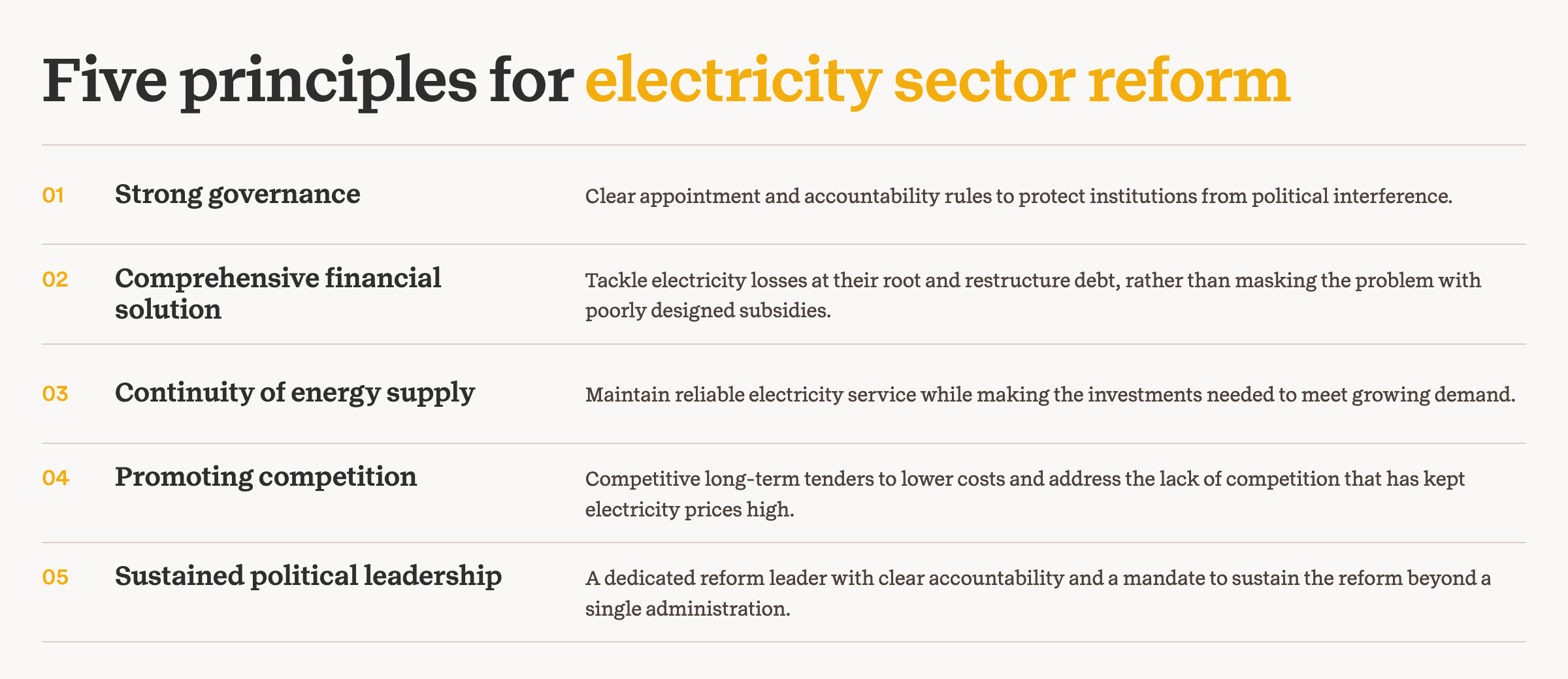
After nearly four months of debate, Honduras has a new law for its electricity sector. Approved by the Honduran National Congress on August 31, the Ley de Justicia Energética took effect on September 29. In our diagnostic of the sector, we proposed five principles to evaluate the reform: governance shielded from political interference, a comprehensive financial solution, continuity of supply and new investment, competition, and leadership to implement it. Using these principles as a benchmark, this note analyzes the main changes introduced by the law and the challenges it leaves open. While the new law marks a step forward in organizing the sector and opening it to competition, it leaves two core problems unresolved: political interference and the financial sustainability of ENEE. Whether the law translates into meaningful reform will depend both on correcting these weaknesses and on effectively implementing the new rules.
Opens the sector to competition
The new framework keeps tenders open to all technologies on equal terms, reopens electricity retailing, returns to CREE (Comisión Reguladora de Energía Eléctrica) the authority to set the threshold for qualified consumersFootnote 1[1] and the value of capacity deviations in the spot market, and recognizes energy storage as an independent activity. In doing so, it reverses much of Decree 46-2022, which reserved electricity retailing to ENEE and restricted private investment. These rules expand supply options and create more space for competition to attract investment and reduce costs.Footnote 2[2]
Institutional architecture improves, but political interference channels remain open
The law splits ENEE into generation, transmission, and distribution, strengthens the independence of CREE, and places system operation outside the state utility. That separation can make the costs and losses of each activity transparent and bring greater objectivity to dispatch. But for this change to be substantive, the new companies need real autonomy.
That autonomy is not guaranteed. ENEE Matriz (the holding company)Footnote 3[3] retains ownership of the assets, appoints the boards of the subsidiaries, approves their bylaws, and preserves authority over governance, procurement, and financing. In addition, it maintains coordination functions that are redundant alongside those of CREE on regulatory matters and the System and Market Operator (OSM) on operational ones. Retaining asset ownership also limits the subsidiaries' capacity to invest, secure financing, and answer for their own decisions. And since ENEE Matriz itself has a politically appointed board of directors, the split risks changing the form without changing the substance: three new companies, but decisions remain concentrated in the same ENEE.
Contracting across the sector is also exposed to a new political layer. Every contract whose effects extend into the next presidential term requires approval from the Honduran National Congress, and since new generation contracts must last at least ten years, the rule applies to practically all of them. The provision also covers other contracts tied to activities regulated under the law, signed by ENEE or its subsidiaries.
Congress has a legitimate role in setting general procurement rules, such as transparency, competition, and oversight. Approving each contract after it is awarded is another matter. A generator can compete, win a tender supervised by CREE, and still be subject to a round of political approval. That uncertainty can delay investment, make financing more expensive, and discourage participation. This is not common practice in other markets across the region. In Chile, the Comisión Nacional de Energía oversees tenders, and in Guatemala, the regulator approves awards without Congress intervening contract by contract.
Increases ENEE’s financial pressure
The law worsens the state utility's finances by freezing a tariff that was already below the cost of supply. The measure will last six months, extendable for another six. Between June and August 2026, generating electricity cost 52% more than projected due to rising fuel prices and lower hydroelectric generationFootnote 4[4]. CREE had already deferred adjustments of $124 million, a cost that users will pay later (with interest) through electricity billsFootnote 5[5]. Under current conditions, the six-month freeze would add another $213 million, bringing the total to $337 million. In a scenario of more expensive fuels and higher thermal generation, it could reach $472 million, equivalent to nearly a third of ENEE's annual revenues from energy sales in 2025Footnote 6[6]. By preventing tariffs from reflecting the cost of service, the freeze weakens the price signal and could make the subsequent adjustment more difficult.
Figure 1
The law itself requires explicit, targeted subsidies with defined financing, but does not clarify who covers the cost of the tariff freeze. This funding gap could lead to additional debtFootnote 7[7], greater fiscal pressure, and fewer resources for fuel, maintenance, and investment. This comes at a time when fuel shortages for leased power plants has already contributed to outages. In Chile, a tariff freeze introduced in 2019 provided immediate relief but created a long-term obligation. It left nearly $6 billion in debt owed to generators, which regulated consumers are repaying, with interest, through an additional charge on their electricity bills until 2035.
Reducing losses offers an immediate opportunity
In 2025, about 38% of generated electricity was not billed, equivalent to more than $500 million. The law requires every meter and account to have an identified holder and responsible party, reinforces measures against electricity theft, and mandates progress toward smart metering. But reducing losses also requires upgrading distribution networks, regularizing connections, and improving billing. The law provides tools, but results will depend on adequate funding and effective implementation.
Attracting investment requires more than meeting deadlines
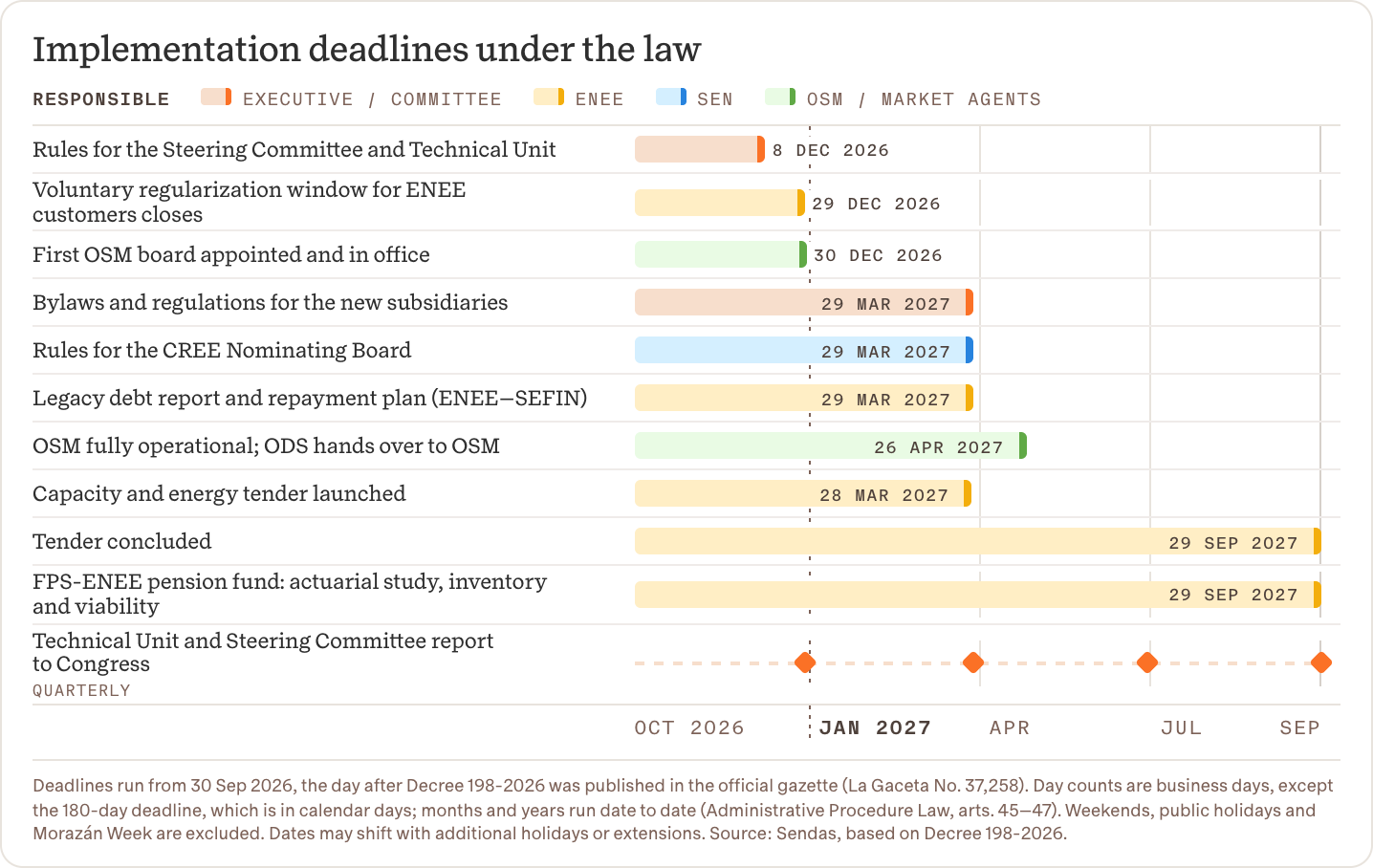
The first tender must begin before March 29, 2027 and conclude in September. But meeting that schedule does not guarantee that new generation will arrive on time. By 2029, Honduras will need to add new firm capacity equivalent to nearly 60% of its current operating capacityFootnote 8[8], yet a new generation project can take three to five years from the investment decision to becoming operational.
To attract investors, the process will require an independent and operational OSM, clarity on who contracts and pays, well-defined regulatory rules, and greater certainty regarding ENEE's ability to pay. Planning must extend several years into the future, ensure that transmission infrastructure is ready when new generation comes online, and provide certainty regarding when energy will be needed and the terms under which it will be contracted.
Implementation demands leadership and results
Implementation begins with a demanding timetable: by March 2027, the regulations, subsidiary bylaws, debt plan, and the commissioning of the OSM must be underway. But the Comité de ConducciónFootnote 9[9] and the Unidad Técnica must not limit themselves to managing deadlines. The reform needs someone with the authority to lead it, set priorities, unblock decisions, and demand results. Implementation must be managed as a single project, through a critical path connecting transmission investments, tenders, the OSM, the separation of ENEE into subsidiaries, and loss reduction, with clearly assigned responsible parties, verifiable targets, and public tracking.Footnote 10[10]
The priority now is to execute what was approved and correct the weaknesses that persist. The first task is to ensure power supply in 2027. Separating the companies, establishing the OSM’s independence from ENEE, and fulfilling the remaining obligations under the law will be of little value if continuity of service is not guaranteed.
But securing supply also requires improving ENEE's finances and reducing losses. Until the utility can make payments on time, every new contract will be more expensive and investment more difficult to finance. And as long as a significant share of electricity remains unbilled, ENEE will continue to lack the resources it needs to operate and invest.
Without sound finances, there is no investment; without investment, there is no reliable electricity supply; and without reducing losses, finances cannot recover. Breaking this cycle requires a long-term transformation of ENEE, with political and financial support, and an independent CREE capable of upholding the new rules beyond a single administration.